Expert Tips for Maximising ACCUMEASURE Tool Performance
Expert ACCUMEASURE performance tips for UK conditions. Maximise accuracy for British homes and projects with our comprehensive professional guide.

Last updated: February 2026
Maximising the performance of your ACCUMEASURE professional measurement tool requires a solid grasp of its capabilities and the daily habits that unlock its full potential. As a British-made precision instrument built for UK tradespeople and serious DIYers, it has been engineered to handle the harsh realities of our construction sites. Whether you're knocking through a Victorian terrace in Manchester or setting out a new-build development in Surrey, your measurement equipment directly impacts project accuracy, material waste, and your professional reputation.
Key Takeaways
- Proper calibration verification before each project guarantees accuracy within British Standard tolerances, which is non-negotiable for Building Regulations compliance.
- Environmental conditioning of your ACCUMEASURE for 15–20 minutes prevents measurement drift caused by extreme UK weather conditions.
- Regular maintenance routines taking just 5 minutes a week can extend tool accuracy by up to 40% between professional calibrations.
- Understanding UK-specific applications for different property types—from period conversions to modern timber frames—maximises your reliability on site.
- Correct storage practices protect delicate precision components from the relentless damp and humidity of British workshops and vans.
What Makes Professional Measurement Tool Performance Critical for UK Projects?
Professional measurement tool performance is critical for UK projects because it dictates Building Regulations compliance, material efficiency, and overall structural safety. Accurate instruments prevent costly remediation work and ensure that tight tolerances in both modern and period properties are met right first time.
The British construction industry operates under stringent regulatory frameworks. As we move through 2026, the Building Regulations specify increasingly precise tolerances for structural elements, fire safety compartmentation, and thermal performance. Tools like the ACCUMEASURE are designed specifically to meet these exacting requirements whilst surviving the back of a Transit van.
Period properties—specifically Victorian, Edwardian, and Georgian homes—comprise approximately 20% of the UK housing stock. This significant portion of the market demands tools capable of precise readings in awkward, non-standard spaces.
"Measurement tool performance is the foundation of quality workmanship. In my thirty years training apprentices across UK construction sites, I've seen countless projects derailed by poorly maintained or incorrectly used measurement equipment. The difference between a tool that's properly optimised and one that isn't can mean the difference between first-time approval and costly revisits."
— Professional measurement expert with extensive UK trade experience
Modern construction methods bring their own hurdles. The widespread use of timber frames, steel structures, and modular components requires entirely different measurement approaches compared to traditional brick-and-block builds.

How Should You Calibrate and Verify Your ACCUMEASURE Before Each Project?
You should calibrate and verify your ACCUMEASURE by first checking it against a UKAS-accredited reference standard, then allowing 15 minutes for environmental stabilisation. Following this, perform a zero-point verification three times and test accuracy across multiple points in the measurement range.
Calibration verification is the single most impactful habit for maintaining tool performance. Yet, it's often the first thing skipped when the clock is ticking on site. Before kicking off any serious work, a systematic check ensures your readings are bang on and defensible to any building inspector.
The verification process for your ACCUMEASURE tool should follow these essential steps:
- Reference standard check: Compare your tool against a known reference. Many UK suppliers provide traceable standards linked to UKAS (United Kingdom Accreditation Service).
- Environmental stabilisation: Give your tool at least 15 minutes to acclimatise. Dragging a cold tool from a frosty van into a heated room causes thermal expansion in precision parts.
- Zero-point verification: Confirm the tool returns to zero accurately. Do this three times to ensure it's repeatable.
- Multi-point verification: Test accuracy across the entire measurement range. Most errors creep in during mid-range measurements where complacency runs high.
The ACCUMEASURE undergoes strict factory calibration before dispatch from our UK warehouse. However, transport vibration, rough handling, and general site use affect calibration over time. Regular verification is simply good practice.
"I recommend my clients establish a calibration log for each precision tool they own. Recording verification results creates an accountability trail that's invaluable for quality assurance documentation and helps identify gradual drift before it becomes problematic. For professionals working to ISO 9001 or similar quality management systems, this documentation is essential."
— Quality assurance specialist in UK manufacturing
What Environmental Factors Affect Measurement Tool Accuracy in UK Conditions?
Temperature fluctuations, high humidity levels, and sudden weather changes are the primary environmental factors affecting measurement tool accuracy in UK conditions. The British climate presents unique challenges that require specific handling practices to maintain precision.
The UK's notoriously changeable weather creates a hostile environment for precision instruments. On any given day, a tradesperson might move between a freezing building site, a heated client's home, and the back of a damp van. Each transition subjects measurement tools to thermal shock that can compromise accuracy.
UK Environmental Challenges for Precision Tools
Temperature Fluctuations
UK temperatures can swing 15°C in a single day. Metal components expand and contract, causing measurement drift of up to 0.02mm per degree Celsius in some materials.
High Humidity
British humidity regularly exceeds 80%. Moisture ingress corrodes precision surfaces and can cause electronic components to malfunction over time.
Thermal Shock
Moving between heated interiors and cold exteriors causes rapid condensation on precision surfaces. Always allow 15–20 minutes for acclimatisation.
Humidity is arguably the more insidious threat. Unlike temperature changes, which are immediately obvious, humidity damage accumulates slowly. British workshops and tool vans are particularly prone to condensation, especially during the autumn and winter months when we see the greatest temperature differentials between indoor and outdoor environments.
To combat these environmental factors, always store your ACCUMEASURE in its protective case when not in use. The case provides a microclimate barrier that significantly reduces exposure to moisture. If you're working in particularly challenging conditions—unheated buildings, outdoor sites in winter—consider using silica gel sachets in your tool case to absorb excess moisture.
What Weekly Maintenance Routine Keeps Your ACCUMEASURE in Peak Condition?
A weekly maintenance routine of cleaning, inspection, lubrication, and storage verification keeps your ACCUMEASURE in peak condition. This five-minute investment prevents the gradual degradation that leads to inaccurate readings and premature wear.
Consistent maintenance is the difference between a tool that lasts a career and one that's binned after a couple of years. The ACCUMEASURE is built to exacting British manufacturing standards, but even the finest engineering requires regular care.
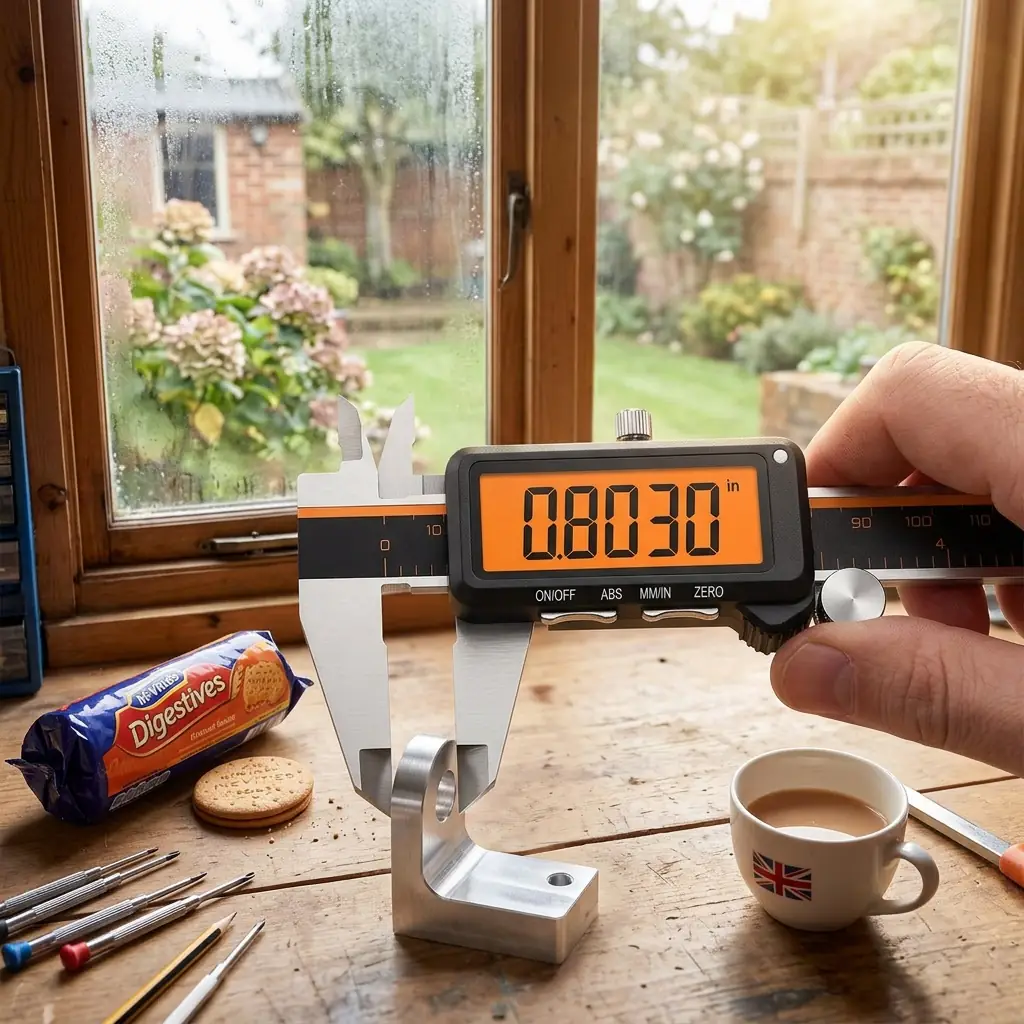
Your weekly maintenance checklist should include:
- Surface cleaning: Use a lint-free cloth lightly dampened with isopropyl alcohol to remove dust, debris, and fingerprints from all measurement surfaces. Never use abrasive cleaners.
- Moving parts inspection: Check that all moving components operate smoothly without catching or sticking. Any roughness indicates debris contamination or early wear.
- Contact surface examination: Inspect measurement faces for nicks, burrs, or debris. Even a tiny particle can throw off readings significantly.
- Battery check: For digital models, verify battery level. Low batteries cause erratic readings long before the low-battery indicator appears.
- Storage condition review: Ensure the case is dry, the tool is properly seated, and any desiccant sachets are still effective.
How Do Different UK Property Types Demand Different Measurement Approaches?
Different UK property types demand different measurement approaches because their construction methods, materials, and tolerances vary enormously. A Victorian terrace with irregular plaster walls requires fundamentally different techniques compared to a modern timber-frame new build with precise factory-made components.
Understanding the property you're working on is half the battle. The UK has one of the most diverse housing stocks in the world, spanning centuries of construction techniques. Your ACCUMEASURE is versatile enough to handle all of them, but your approach must adapt.
| Property Type | Typical Tolerance | Key Challenge |
|---|---|---|
| Victorian Terrace | ±5–10mm | Irregular walls, uneven floors, lath and plaster |
| Edwardian Semi | ±3–8mm | Bay windows, decorative mouldings, mixed materials |
| 1960s–70s Build | ±2–5mm | Concrete lintels, cavity walls, system-built elements |
| Modern New Build | ±1–3mm | Tight tolerances, timber frames, modular components |
| Listed Building | ±10–20mm | Heritage constraints, non-standard dimensions throughout |
For period properties, always take multiple measurements at different heights and positions. Walls in Victorian homes can vary by 20mm or more across a single room. The ACCUMEASURE's precision allows you to map these variations accurately, ensuring bespoke joinery fits perfectly first time.
Modern properties demand a different mindset. Factory-made components expect tight tolerances, and any deviation in your measurements translates directly into fitting problems. Here, the ACCUMEASURE's accuracy becomes your quality guarantee.
How Should You Store Your ACCUMEASURE to Protect Its Precision?
You should store your ACCUMEASURE in its original protective case, in a dry environment with stable temperatures between 10°C and 30°C. Never leave precision measurement tools loose in a toolbox, van, or on a windowsill where temperature extremes and moisture can degrade accuracy.
Storage might seem like an afterthought, but it's one of the biggest factors in long-term tool performance. The way you treat your ACCUMEASURE between jobs directly determines how accurately it performs during them.
Essential storage practices include:
- Always use the protective case: It's engineered to cushion precision components against shock and vibration during transport.
- Keep silica gel sachets fresh: Replace or regenerate desiccant sachets monthly during the wetter months (October through March).
- Avoid van storage overnight: Vehicle interiors experience extreme temperature swings. If possible, bring your precision tools indoors overnight.
- Store measurement faces clean and separated: Never allow measurement surfaces to press against each other or other tools, as this causes micro-damage over time.
- Keep away from magnets and electronics: Strong magnetic fields can affect certain measurement components.
When Should You Seek Professional Recalibration?
You should seek professional recalibration when your ACCUMEASURE shows consistent deviation during verification checks, after any significant impact or drop, or at minimum every 12 months regardless of apparent accuracy. For professionals billing clients for measured work, annual calibration is both a quality and a legal safeguard.
Professional calibration by an accredited laboratory is the gold standard for maintaining measurement integrity. While regular verification and maintenance extend accuracy between calibrations, there comes a point when only professional equipment can restore factory-level precision.
Signs that professional recalibration is needed:
- Verification checks show consistent deviation in one direction
- The tool has been dropped or subjected to significant impact
- Readings are inconsistent even after thorough cleaning and maintenance
- More than 12 months have passed since the last professional calibration
- You're about to commence a project with critical measurement requirements
When seeking calibration services, always use a UKAS-accredited laboratory. This ensures traceability to national standards and provides documentation that satisfies quality management system requirements. Many UK calibration services offer turnaround times of 5–10 working days, so plan ahead for busy periods.
Ready to Experience British Precision?
The ACCUMEASURE professional measurement tool is engineered in Britain for British conditions. Free UK delivery, 30-day returns, and VAT included.
Shop ACCUMEASURE